
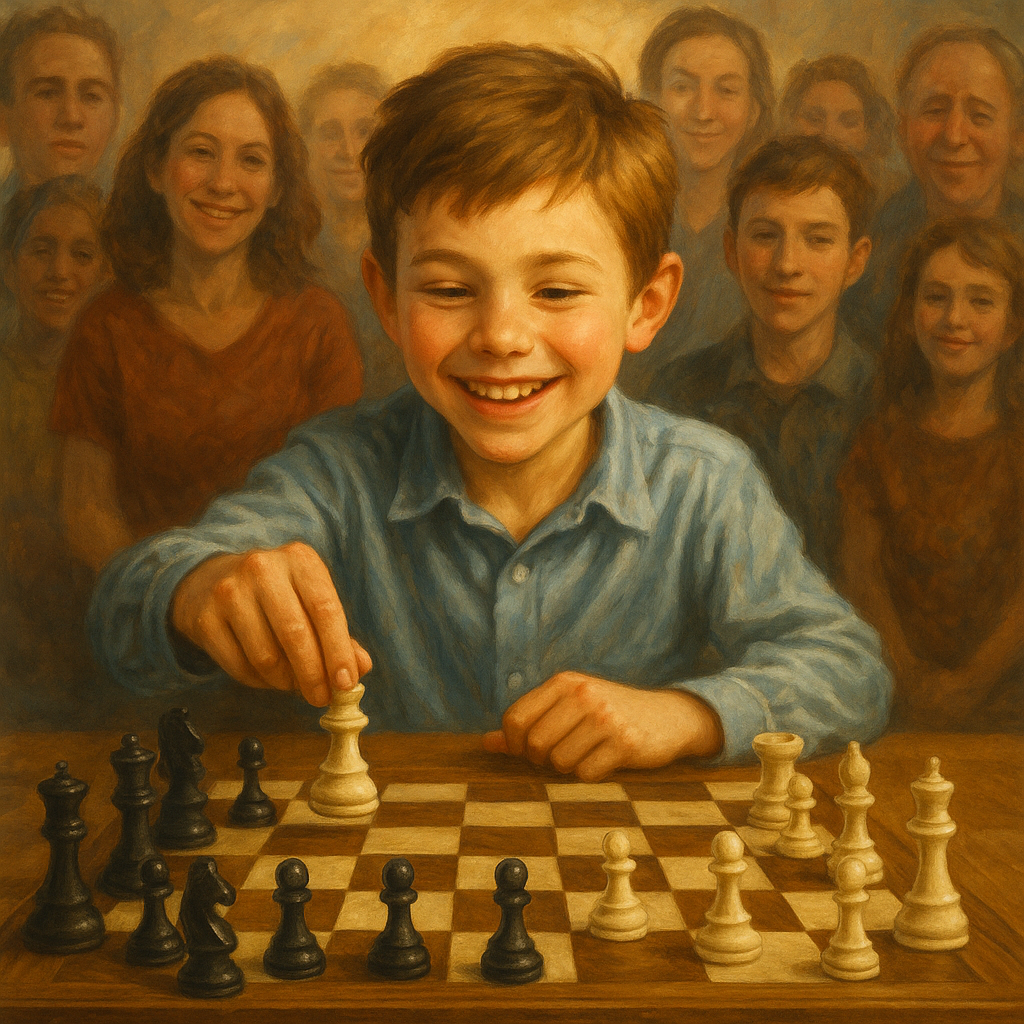

Charles didn’t really like being around people, not even when he was a little kid. Big crowds, loud noises, and new faces often made him feel like he was caught in a whirlwind, impossible to control. Even something simple like walking through the hallway at school felt like a jungle — voices and footsteps and laughter all mixing together. So, he found peace in his room, a quiet space where he could think and relax.
Puzzles became his thing. Every week, his parents would bring home a new one, and Charles would spread the pieces out on the floor. He’d spend hours sorting through them, fitting the pieces together, and finishing the picture one bit at a time. Each time he completed a puzzle, it felt like a little win in a world that sometimes felt out of control. Eventually, puzzles got too expensive, so they borrowed them from friends, neighbours, or even the toy library.

One day, his dad brought home a chess set. It was simple, just black and white squares with little pieces neatly lined up. But to Charles, it was like opening the door to a whole new world. His dad explained the rules, and Charles listened closely, picking up everything. When they played, Charles understood the moves right away. Within a day, he had beaten his dad, and after a few weeks, he couldn’t be stopped.

Charles thought like lightning when he played. He could figure out moves, predict what was coming, and take risks. His dad couldn’t win anymore, and soon, Charles was playing online, where no one could see him, and he could just focus on the game. He read chess books like they were the most exciting stories, learning strategies, tricks, and moves. His rating kept rising, faster and faster. Before long, he was noticed by the online chess community, and he got invited to play in real-life tournaments.

The day of his first tournament, Charles felt like he was walking into a hurricane. The noise, the whispers, the footsteps, and all the people talking about their strategies were overwhelming. He lost fast — eliminated before he could even reach the top 16. That night, Charles felt like he was drowning in a storm of anger, sadness, and self-doubt. He thought he was terrible at chess.
But his dad saw things differently. Charles had still won four games and made it to the top 32, and he handled himself well in the tournament, staying calm and polite. His dad told him, “You didn’t lose, you learned. You did great.”
Charles didn’t want to hear it. “They were laughing at me. I couldn’t think right. I’m just dumb,” he said.
His dad sat down with him. “Do you not like chess anymore?” he asked. Charles shook his head. “I lost.”
“You’ll win next time. Sometimes you win, sometimes you lose. That’s part of the game,” his dad said.

“I don’t like losing,” Charles replied.
“Losing isn’t failing. Losing teaches you. Imagine winning all the time — it would be boring! The real fun is in the challenge, in getting better.”
Charles wasn’t sure what to think. “You want me to lose on purpose?”
“Not at all,” his dad said, laughing. “But losing teaches you things. Every time you lose, you learn something new. Even the best players lose sometimes.” He showed Charles a photo of an Olympic gold medallist. “This guy won all the time, but when he retired, he didn’t know what to do next. Winning all the time isn’t everything. What matters is growing and enjoying the journey.”
That night, Charles had a dream. In the dream, he was winning every match and holding a huge trophy above his head. The crowd cheered, but when he looked around, he was alone. There were no friends or family, just the weight of the trophy in his arms. It felt empty. Then, the cheering came back, and the trophy was in someone else’s hands. But his parents were still proud of him. They were proud of the effort, not just the win.
When he woke up, Charles realized something important: Success wasn’t just about winning. It was about learning, growing, and enjoying the journey. The excitement came from every clever move, every new strategy, not just from the final score.

The next day, he went back to playing online chess. This time, he focused on getting better, not just on beating everyone. Every new move he learned made him feel more excited. And each mistake he made was a chance to improve. His dad made him promise that they would high-five every time Charles lost. They even made up a handshake for every lesson he learned from a game.
As time went on, Charles discovered something better than winning. Chess had taught him patience, persistence, and how to keep going even when things get tough. Winning was awesome, but learning and growing? That was the real thrill.
From then on, Charles played chess with a quiet confidence. He still loved the competition, but he had learned to enjoy every moment, every game, and every challenge. And for the first time, he felt like he truly belonged in the chess world, no matter how noisy it got.
