
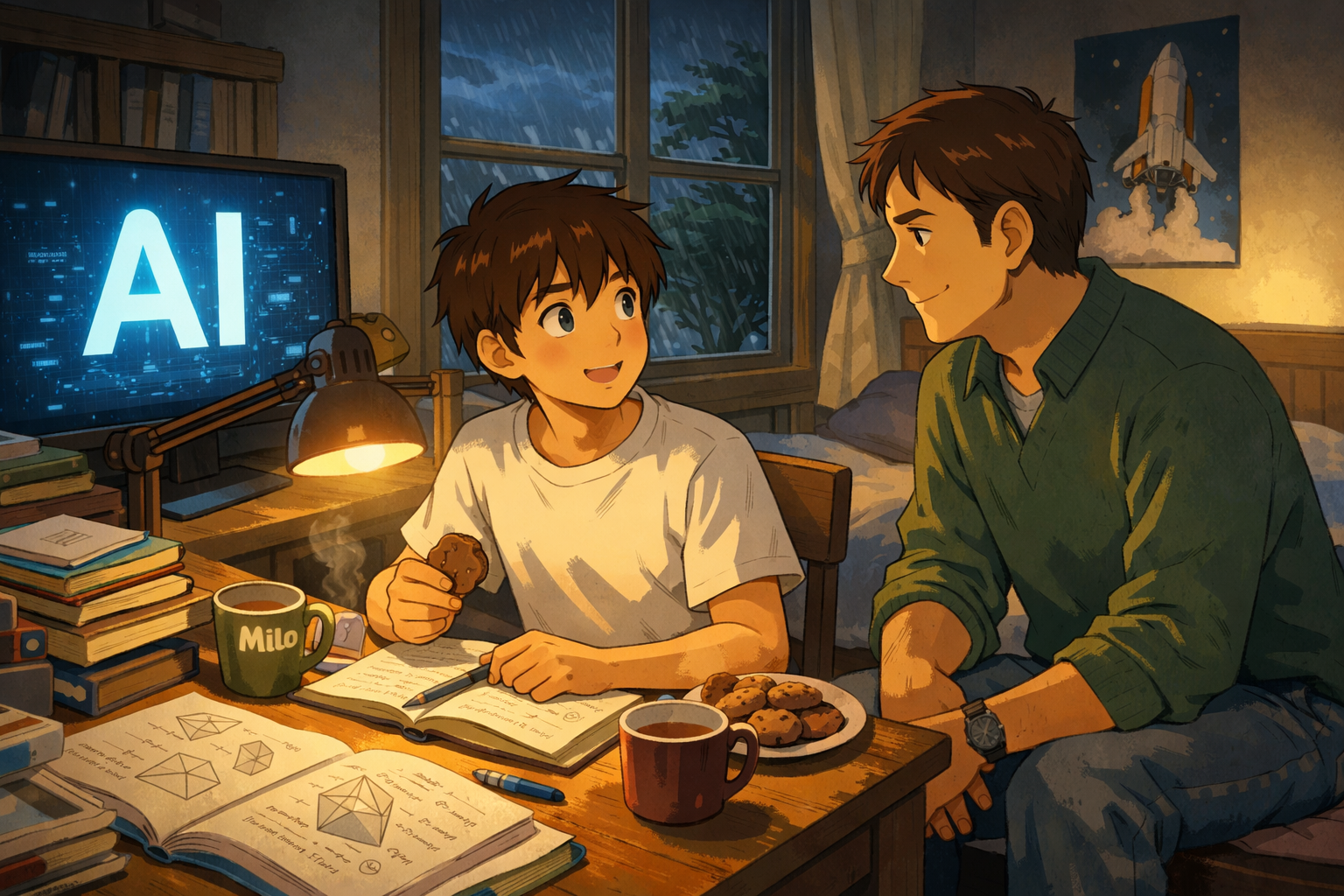
Late at night, the wind hammered against the house.
James sat under his desk lamp, still wrestling with the Vector Geometry in 3D questions. The test was tomorrow, and he hadn’t wrapped his head around it.
A soft knock came at the door. His mum stepped in with cookies and a mug of Milo. Sugar was always welcome during late-night study. James finally put down his pen and dunked a cookie into the Milo. The warmth made him feel a little less tense.
“Mom… why do we need to study anyway?” he blurted out. “Uncle Sam told Dad the other day that eighty per cent of what they learned in school was useless in their jobs. So… what’s the point?”
He slumped back. Year 12 was crushing him. Exams were getting closer by the day. His dad had helped him build a study schedule, and between school, tutoring, homework, and extra activities, he barely had time to breathe. Hearing his father call schoolwork “useless” only made him feel worse.
His mum smiled gently. “I think your father needs to answer that,” she said, and slipped out.
A moment later, another knock.
His dad stepped in and sat on the edge of the bed.
“Sorry, mate,” Andrew began, his voice steady but warm. “Sorry you heard my complaints the other day.”
He sighed. “You know, I asked your grandfather the exact same question when I was your age. And if I remember right, your Uncle Sam and I even came up with a whole plan to convince him to let Sam drop out of school.”
James’ eyebrows shot up.
“It’s true,” Andrew said. “Your granddad was harder on Sam than on me or your aunt. Being the eldest meant he had to be the example. But he also got the best opportunities—private school, extra support—you name it.
“When he was seventeen, Sam hated his boys’ school so much he tried to get out by joining the Army. Granddad said no. He argued that too much had been invested in Sam’s education already. But Sam fought back. He wanted Navy or Army, no matter what. The argument got so big he almost ran away.”
“What happened?” James asked eagerly.
“Granddad finally compromised. He agreed to let Sam try a three-week Army camp. If he enjoyed it and got good recommendations, he could enlist after Year 12.”
Andrew chuckled. “Sam came back darker, thinner, crew-cut, and in full uniform. But he never mentioned the Army again. He finished Year 12 and went to university like planned. When I asked what changed, he just said, ‘Following orders without question isn’t for me.’ And that was that.”
Andrew looked James in the eyes. “If you want to do something different, I’ll support you. But finishing Year 12 gives you choices. An ATAR opens more doors than it closes.”
James clenched his fists. “But why study geometry if I’m going to be an accountant, or a PE teacher, or… I don’t know… anything else?” His voice cracked. The frustration had been building for months.
“I get it,” Andrew said. “A lot of knowledge fades over time. But it’s not really about the formulas. Let me ask you something: why did you pick Specialist Maths? You could’ve chosen General Maths.”
James stared at the Milo. “I used to want to do engineering at RMIT, and they require Specialist Maths. But now… with AI replacing everything, I don’t even know anymore. Coding, computers, even gaming—AI can do it all. What hope do we have?”
Andrew smiled. “That, son, is critical thinking. And you didn’t develop that by accident. Twelve years of school did that. You analyse. You reason. You ask the right questions. Do you think a twelve-year-old could ask what you just asked?”
He leaned forward. “AI can copy and combine ideas. But real innovation—new theories, new methods, new thinking—still comes from human logic and imagination. Self-aware AI? We’re decades away. But you? You’re already thinking like a problem-solver. I’m proud of you.”
James blinked, half amused. He had never seen his dad so fired up.
“Dad… this isn’t like you,” he said with a half-smile. “I get the whole critical thinking thing. But it doesn’t help me with this geometry test. What good is logic if I fail tomorrow?”
Andrew laughed softly. “Critical thinking is worth more than any one test. But it can help you with this too. How about a game?”
“A game?”
“Yeah. It’s called ‘Spot the Pattern.’ Look at the worked examples. Find the pattern or logic behind them. Then use that pattern in the exercise questions.”
It sounded almost too simple. But James tried it.
And within minutes, something clicked.
He found the pattern. He understood the logic. Suddenly the questions that felt impossible made perfect sense. His pencil raced across the page, and he finished the entire exercise set faster than ever.
“I don’t get it,” James whispered. “I thought these were meant to be very difficult because it’s Specialist Maths…”
Andrew chuckled. “And you didn’t think you were a Specialist Maths genius?”
James rolled his eyes, but he was smiling now.
“A small shift in thinking can change everything,” Andrew said. “School isn’t just memorising facts. If that’s all you do, you’re training yourself to be an AI. You’re learning how to think—how to learn quickly, see things from different angles, ask the right questions, find patterns, and use them to solve new problems.”
He patted James on the head. “That’s what makes you better than any machine. Whatever you choose to do in the future, go for it wholeheartedly. AI is a tool—not a replacement.”
The night grew deeper. The Milo mug was empty.
But for the first time in a long while, James felt something he hadn’t felt in months.
Confidence.
About tomorrow’s test.
And about his future.
